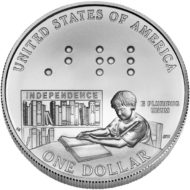
3D printing a replica of the Helen Keller Quarter

Collecting coins without any vision has a major disadvantage: it is hard to tell what exactly is on a coin, as it is hard to feel the details. One can feel where there is writing, a head, a building, an animal, etc. But the minor details are too small for touch, which applies to most coins. When a coin is large enough, one can feel the dates, and on many coins, you can also feel the denomination.

I was always interested in the small details, and generally I used coin catalogs or sighted assistance to learn about it. But there is a way to get around it: creating a much larger copy where the details are sufficiently large to feel. This can easily be done using 3D printing.

When I added 3D design and production to my business services, you may have guessed, the first thing I got designed was a coin.

In this post I will describe the challenges and solutions of 3D printing an Alabama Quarter.

Continue reading “3D printing a replica of the Helen Keller Quarter”

The guide dog who visited the most money museums

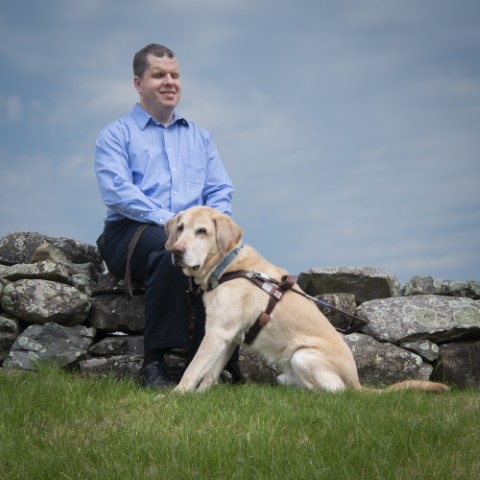
From 2014 until about 2022, I was traveling with my guide dog, Baldwin. He has been to 12 money museums, in 6 countries and 11 cities.

On October 20th, at the age of 13, he died. While it is not a blog about my guide dog, I still felt appropriate to post this, since many of you who read the blog or the newsletter met him in person. Also, without his passionate work, I don’t think I would have been able to visit all the places we have been to.

Tom and Baldwin
Continue reading “The guide dog who visited the most money museums”

Mint Museum in Madrid, museo casa de la moneda

I was wrapping up a conference in Spain and I had a few extra hours in Madrid. Without a doubt, I knew that if I’ll have time for one more thing, it will be the Mint Museum, Museo Casa de la Moneda. Given that still most money museums are still not accessible, generally I make arrangements well in advance to visit and ask if they could provide a tactile experience for me. But since I wasn’t sure I would be able to make it, I didn’t want to ask for kindness and cancel the visit last minute.
Continue reading “Mint Museum in Madrid, museo casa de la moneda”

Tactile marks on currencies

Tactile marks on currencies

This post is primarily created to help blind people who travel to a different country and would like a quick reference on how to recognize the local currencies. There is of course currency recognition apps which one can use, here I will only concentrate on currencies, which do have tactile features. I will explain how to interpret those features.

Continue reading “Tactile marks on currencies”

The Bank of Canada Museum

A few days after my presentation about accessible coin exhibits, I got a call from the Bank of Canada Museum, which was previously called the Currency Museum, to enquire about my presentation, and it turned into an on-site visit. I spent a day with the museum’s employees where we discussed my ideas about accessible exhibits, coin collecting, accessible currencies and many other fun things.

Continue reading “The Bank of Canada Museum”

Recognizing coins with artificial intelligence

Over the last year, many new opportunities became available for me to learn about coins with the use of artificial intelligence. These developments truly open a new chapter in what coin collecting could mean to me without vision.

Previously I wrote a lot about recognizing coins with technology, so far what is still working and available is Seeing AI by Microsoft. What I was able to do is using optical character recognition to get enough text from a coin to tell what it is. It mostly works with good quality coins and good quality pictures. After I determine what a coin is, I use Numista to get more information, however, what I am able to get really depends on the descriptions users provide.

Continue reading “Recognizing coins with artificial intelligence”

Really BIG Money at the Smithsonian

Recently I learned that the Smithsonian has a new accessible exhibit, called Really BIG Money. And you know me, I just need to check things like that, so I used the excuse that flying home from Cincinnati there was no direct flight and I had to switch flights in Washington DC. Layovers are where good things happen.

I contacted Jennifer Gloede, who put me in touch with Ellen Feingold, who set up a meeting with me, and was very kind to work with my schedule so I could visit the exhibit on my way home.

Continue reading “Really BIG Money at the Smithsonian”

Tactile coin exhibits

Last month I attended the Leadership Exchange in Disability and the Arts conference in Boston. I was very interested in the conference, so when I decided to attend, I thought it would be great to contribute something interesting. Given that not too many accessible and tactile coin exhibits exist, I submitted a short proposal about how to make coin exhibits accessible for blind people.

Continue reading “Tactile coin exhibits”

We will send people to Mars before the US will have tactile currency

According to Coin World, the Bureau of Engraving and Printing confirmed that we will have a tactile $10 bill by 2026. The initiative is not new, the first research to print tactile Dollar bills started in the 1990’s. But let’s look at what this really means.

Continue reading “We will send people to Mars before the US will have tactile currency”